
Why we worry: The ABC method for mindfully managing worry
我们为何担忧:用心管理忧虑的 ABC 方法
We spend a lot of time worrying. About work, money, friends, family, the future. For most people, it’s not the kind of paralyzing worry that prevents us from getting anything done. It’s more akin to background noise which we can be pretty good at ignoring. But it’s still there.
我们花很多时间担忧。担忧工作、金钱、朋友、家人、未来。对大多数人来说,这种担忧并非那种令人瘫痪、寸步难行的程度。它更像是背景噪音,我们很擅长忽略它。但它依然存在。
It makes it harder than we’d like to fall asleep, and it sometimes hinders our decision-making when we focus on what could go wrong instead of what could go right. Worrying can lead to fatigue and irritation. If it’s so bad for us, why do we worry? Why is it that such an anxiety-inducing mental state is so common?
担忧会让我们难以入睡,有时还会妨碍我们做出正确的决定,因为我们总是关注可能出错的事情,而不是可能顺利的事情。担忧会导致疲劳和烦躁。既然担忧对我们如此有害,为什么我们还会担忧呢?为什么这种令人焦虑的精神状态如此普遍?
Worrying is rewarding
担忧是有益的
Despite all our efforts, we have very little control over our lives. We cannot guarantee outcomes based on effort only. We put in the work, but the future is uncertain. We could get sick, lose someone, miss an important meeting. The number of imponderables is infinite.
尽管我们竭尽全力,但我们对生活的掌控力却非常有限。单凭努力无法保证结果。我们付出了努力,但未来充满变数。我们可能会生病,可能会失去亲人,可能会错过重要的会议。不可预知的事情数不胜数。
So we keep asking ourselves: what if…?
所以我们不断地问自己:如果……会怎样?
And research suggests that excessive worriers have beliefs about the positive consequences of worrying, which reinforces their worrying behavior.
研究表明,过度担忧者往往认为担忧会带来积极的结果,这反而强化了他们的担忧行为。
“Each time we worry and nothing bad happens, our mind connects worry with preventing harm,” explains Dr Seth Gillihan, a professor of psychology at the University of Pennsylvania. We unconsciously think that, after all, it was a good thing to be worried.
“每次我们担忧而最终没有发生坏事时,我们的大脑就会将担忧与预防伤害联系起来,”宾夕法尼亚大学心理学教授塞思·吉利汉博士解释说。我们会在潜意识里认为,担忧终究是一件好事。
A study assessing positive beliefs about worry identified four main factors which may explain why worrying feels, paradoxically, so rewarding:
一项评估人们对担忧的积极信念的研究 发现了 四个主要因素,这些因素或许可以解释为什么担忧会让人感觉如此有益:
- Proactive problem solving. We feel like worrying helps us be more aware of a situation and be better prepared to face it. It might encourage us to come up with more alternative ways to solve a potential problem and avoid the most negative consequences. We see worry as a tool to adopt more productive attitudes, making us responsible, prudent people—the adults in the room.
积极主动地解决问题。 我们认为,担忧能帮助我们更清楚地了解情况,并更好地应对。它或许能促使我们想出更多解决潜在问题的替代方案,从而避免最糟糕的后果。我们把担忧视为一种工具,它能帮助我们培养更积极的态度,使我们成为负责任、谨慎的人——成为房间里的成年人。 - Protection from negative emotions. Worrying feels like it may help us not be caught off guard and be less disappointed if something bad actually happens. We feel like we won’t be as upset if we predicted that particular negative outcome.
避免负面情绪。 担忧似乎能让我们不至于措手不及,如果坏事真的发生,我们也不会那么失望。我们觉得,如果事先预料到某种负面结果,就不会那么难过。 - Positive self-perception. We might see a tendency to worry as a positive personality trait. Worrying about other people may confirm—in our own eyes or the eyes of others—that we are a sensitive, considerate, caring person. We may even feel like people around us would be disappointed if we didn’t worry about them. We basically conflate worrying with being a good person.
积极的自我认知。 我们可能会把爱操心的倾向视为一种积极的性格特征。关心他人或许能让我们——无论是在自己眼中还是在他人眼中——证明自己是一个敏感、体贴、有爱心的人。我们甚至会觉得,如果我们不关心身边的人,他们会感到失望。我们基本上把操心和做一个好人混为一谈了。 - Magical thinking. Finally, we may think that the act of worrying itself can reduce the risk of something bad happening, which, for some people, can be superstitious.
迷信思维。 最后,我们可能会认为担忧本身就能降低坏事发生的风险,而对某些人来说,这可能是一种迷信。
Remarkably, the first factor alone accounted for 32% of the variance in scores in the study. While the authors noted the relatively small sample size, they thought it was worth highlighting the apparent importance of problem solving and motivation.
值得注意的是,仅第一个因素就解释了研究中32%的分数差异。尽管作者指出样本量相对较小,但他们认为有必要强调问题解决能力和动机的重要性。
This factor is particularly relevant for people who are problem-solvers. There’s a fine line between worrying and problem-solving. Worrying is about letting your mind dwell on problems without a systematic approach, often leading to anxiety. Problem-solving is about applying creative strategies and mental models to specific problems.
这一点对善于解决问题的人来说尤为重要。担忧和解决问题之间只有一线之隔。担忧是指让你的思绪在问题上停留,却缺乏系统性的方法,这往往会导致焦虑。而解决问题则是运用创造性的策略和 思维模型 来应对具体问题。
Staying up at night, your mind racing, imagining all of the potentially negative outcomes of a decision—this is worry. Sitting down with a notepad, pen in hand, ready to sketch a mind map and identify potential solutions—this is problem-solving.
夜不能寐,思绪万千,想象着某个决定可能带来的各种负面后果——这是担忧。坐下来,手里拿着笔记本和笔,准备绘制 思维导图 ,找出可能的解决方案——这是解决问题。
Mindful ways to manage worry
用正念的方式应对焦虑
So, how can we manage worry? Is it possible to completely eliminate it? The truth is, no—worry is a natural part of life which we can’t avoid entirely.
那么,我们该如何应对焦虑呢?有可能彻底消除焦虑吗?事实是,不能——焦虑是生活的一部分,我们无法完全避免。
However, while you may not be able to get rid of it altogether, there are simple strategies that can help you reduce its impact. By learning to recognize and manage worry, you can create more mental space for peace and focus.
然而,虽然你可能无法完全摆脱焦虑,但有一些简单的策略可以帮助你减轻它的影响。通过学习识别和管理焦虑,你可以创造更多的心理空间,从而获得平静和专注。
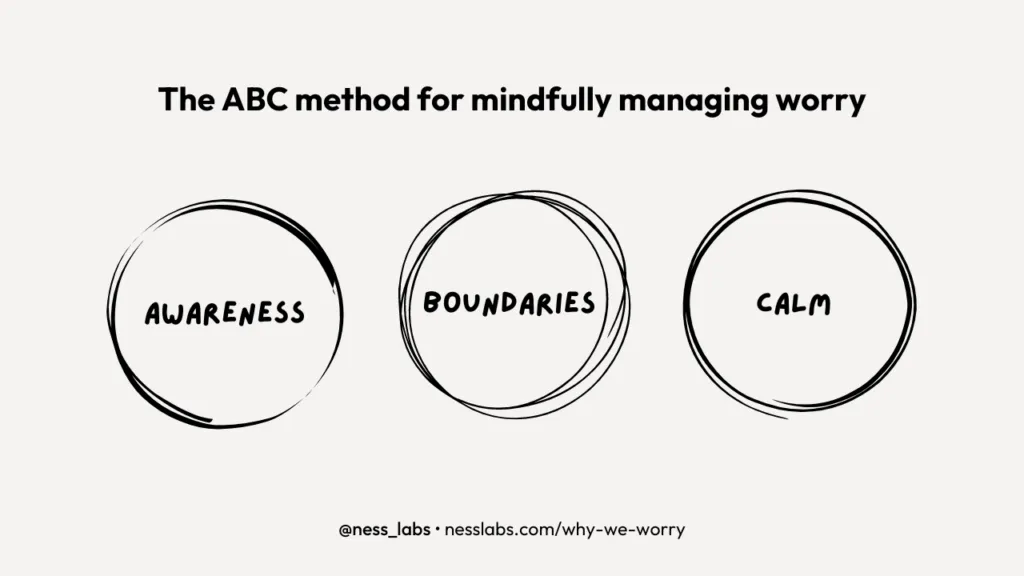
Why We Worry - The ABC Method for Mindfully Managing Worry 我们为什么会担忧——用 ABC 方法正念管理担忧
- Awareness. The first step to managing worry is becoming aware of it. Notice when you start worrying, and instead of trying to push the feeling away, take a moment to study it. Why are you worried? What’s the root cause? This is the power of metacognition: simply acknowledging and understanding what your mind is doing allows you to engage with your worry more intentionally.
觉察。 管理焦虑的第一步是觉察它。留意自己何时开始焦虑,不要试图压制这种感觉,而是花点时间仔细分析它。你为什么焦虑?根源是什么?这就是 元认知 的力量:仅仅承认并理解你的思维活动,就能让你更有意识地应对焦虑。 - Boundaries. Even with second-level thinking, it’s impossible to predict every outcome—and that’s okay. Uncertainty is an inherent part of being alive. While we can’t control everything that happens in life, that doesn’t mean we should hold back from living fully. Setting mental boundaries around what you can and cannot control will help you live with less worry and more freedom.
设定界限。 即使运用 第二层思维 ,也无法预测所有结果——但这没关系。不确定性是生命固有的一部分。虽然我们无法掌控生活中发生的一切,但这并不意味着我们应该因此而放弃充实的生活。设定你能控制和不能控制的心理界限,将有助于你减少焦虑,获得更多自由。 - Calm. Worry is often linked to stress and anxiety. To calm your nervous system, try one or several calming exercises. Breathe slowly, stretch, or meditate. Take a long bath or read a good fiction book. Go for a walk. Watch a movie. While you should not run away from challenges, taking your mind off things for a specified amount of time can restore your sense of calm and improve your ability to think clearly.
冷静下来。 担忧往往与压力和焦虑有关。为了平静你的神经系统,可以尝试一种或多种放松练习。缓慢呼吸、伸展身体或冥想。泡个热水澡或读一本精彩的小说。出去散散步。看场电影。虽然你不应该逃避挑战,但暂时放下烦恼可以让你恢复平静,并提高你的清晰思考能力。
Awareness, boundaries, calm… This is the ABC of managing worry in a mindful way. These strategies are simple, but it doesn’t mean they’re always easy to apply. Dealing with worry often means confronting our fears—whether it’s fear of failure, fear of judgment, or fear of missing out on a better option.
觉察、界限、平静……这是以正念方式管理焦虑的 ABC。这些策略很简单,但并不意味着它们总是容易应用。应对焦虑通常意味着直面我们的恐惧——无论是 害怕失败 、 害怕被评判 ,还是害怕错过 更好的选择 。
Acknowledging our limited control can feel unsettling, but it’s crucial so we can move forward. Instead of wasting mental energy on outcomes we can’t predict or control, we can focus on our output.
承认我们控制力有限可能会让人感到不安,但这至关重要,因为它能帮助我们继续前进。与其把精力浪费在无法预测或控制的结果上,不如专注于我们自身的产出。
Of course, leaving your worries behind takes practice. It’s in our nature to worry. And sometimes, worry creeps on us when we least expect it. But by becoming more aware of your thoughts, setting healthy boundaries around what you can and cannot control, and actively working to calm your mind, you can make worry more manageable.
当然,放下忧虑需要练习。忧虑是人之常情。有时,忧虑会在我们最意想不到的时候悄然而至。但是,通过更加觉察自己的想法,设定合理的界限,明确哪些事情可以控制,哪些事情不能控制,并积极努力让自己平静下来,你就能更好地应对忧虑。
Over time, this process can help you become more compassionate, productive, and creative. In the end, you may even learn how to worry well —using it as a tool for growth rather than letting it hold you back.
随着时间的推移,这个过程可以帮助你变得更有同情心、更高效、更有创造力。最终,你甚至可能学会如何 正确地看待担忧 ——将其作为成长的工具,而不是阻碍你前进的绊脚石。